Are You a Cipher?
27 September 2026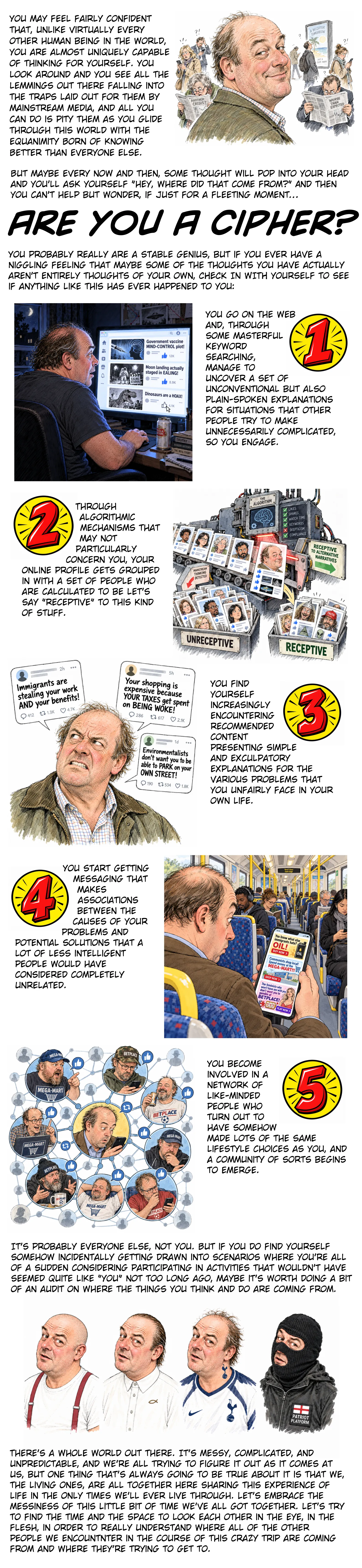
Context: In the course of reading up about the Patriot Platform fiasco on the South Coast of England (see my last comic), I encountered this quote from Beatriz Lopes Buarque of the University of Manchester in an article in the Guardian:
“Racist conspiracy theories are profitable to tech companies and, consequently, there is little incentive on their part to reduce their amplification.”
It’s hardly the first time a version of this point has been made, but I found Dr. Buarque’s phrasing particularly on-point, and it got me thinking about the way that hateful online messaging becomes a very convenient lure in a nasty form of bait-and-switch marketing.
I’ve made this comic in reaction to a process I’ve noticed where some people who consider themselves to be “independent thinkers” turn out to be, ironically, especially susceptible to being told how to behave, not only as thinkers but also as consumers, workers, communicators, and just in general. The process tends to begin with some kind of isolating incident where some event that happens on a national or global scale impacts an individual in an especially negative way - Covid seems to have been a watershed moment for this, as far as I can tell. The individual in question will find alternative, typically conspiratorial explanations for the damaging event, explanations that inherently support the narrative that they have suffered unfairly. It may not always begin with some kind of overt adversity, and the instigating incident may be more of an ongoing situation than a moment, but regardless of how it starts, these individuals find themselves in a kind of funnel that propels them towards a more general world view in which they increasingly see themselves as isolated truth-seekers in a world befuddled by complacency in the face of false complexity.
Once they’ve begun to slide into the trap of simple solutions to complicated problems, these folks tend to begin to see conspiracy and calumny everywhere. Racism, sexism, xenophobia, and other modes of bigotry become tragically convenient devices for amalgamating these individuals into a unitary demographic that can be targeted for manipulation. People who have bought into basic explanations that cast some “other” as a root cause of an issue in their lives are accordingly primed to be targeted with “solutions” that are really about manipulating their behaviour, not fixing their problems. To be clear, I don’t mean to suggest that there is anything much more intentionally sinister than standard marketing practices going on here: everything any of us encounter through social media and online content exists to support getting us to behave in a certain way with our money, our endorsements, our votes, and most of us know this even if we choose not to think about it too much. But there is a vicious correlation between the people who are willing to be led down a garden path, the people who are ready to blame someone different for their problems, and the people who can be coerced to act in a certain way out in the marketplace, and the market, being the apathetic optimiser that it is, identifies this and acts on it.
But if you detect a hint of ambiguity in the conclusion to the comic, that’s not entirely accidental. I don’t think it’s my place to single out a specific group of people or a particular set of beliefs as especially wrong or daft - even if I have done this anyway in my comic by way of telling a specific story about a general phenomenon (and I will say I do think bigotry is pretty daft, no matter how it’s dressed up). And so when I say we all need to find a way to really see one another, I do really mean that for every one of us: we’ve got to find a way to give each other a break and put the innate human ability to see things from more than one point of view to good use. Otherwise other forces will use it for us, and then bad things happen.