Memorable Fancies
Started September 2026, ongoing, currently liveI’d like to think that I’m someone with a relatively vivid visual imagination. I believe I find it easy to close my eyes and picture scenes with a great deal of detail. My dreams are often visually elaborate, and are occasionally very colourful, and even lying awake in the dark or with my eyes closed I find it easy to lapse into a state of what might pass as mild hallucination, where all sorts of weird things flicker before the eye of my mind.
And yet… I am utterly rubbish at actually creating images. Certain as I feel about the clarity with which I can imagine a scene unfolding, I am equally incapable of thinking of the tools I would use and the moves I would make with those tools to actually draw something much more complex than a stick figure. I have to admit that it makes me wonder if I’m just kidding myself about my visual imagination, like it’s just some weird form of response bias where, just as participants in studies are liable to misconstrue their recollections of experiences in predictable ways, I’m prone to falsely remembering that I envisioned anything much at all.
Interestingly – and purely anecdotally – some of the people who I know who are most talented at creating images tell me that they are not visual thinkers, not people who find it easy to picture things in their mind’s eye. It leads me to wonder if there’s something about learning how to outsource that sort of thinking to the world that enables the creation of good, real pictures: maybe talented artists can use tools and media to begin to explore how an image could look, through a process of trying things out and gradually refining what begins as a rough shot at something into an output. I think maybe there’s a connection between this idea about how visual artists work and research into the way that dancers use a “marking” strategy to improve their art by working through versions of their performances at different levels of abstraction.
This project is my attempt to use generative AI to help pull some of what I think I can see in my head out into the world. I’ll be doing this in the form of comics I come up with, intended as commentary on things that are happening out there in the world, in politics, around technology, or just in society in general. What I’m doing here is analogous to my hypothesis about how artists work through a process of tool-enabled discovery and refinement in only the most abstract way, because the process of bringing what I picture into the world is mediated by words that are processed by an algorithm that is nothing other than a lossy decompressor, mapping my sentences onto an approximately recalled version of someone else’s work. The visual thing that comes out the other end of a model I prompt cannot be said to have started in my own head, and I am sensitive to some of the problems around the way that work that was used to build models without permission from the original creators might become incorporated into how my prompts get processed.
I also want to be a bit careful about the other side of this, though. If I’m someone who struggles with creating images, I would say I am also, at least in relative terms, someone for whom it is fairly easy to find the right words to express what I’m thinking. By the same token, I am aware that there are people who do not find expression through langauge easy, for a number of reasons, from proficiency with a particular language to how much practice someone has had or just basic differences in the ways we all think. I think there is a version of these generative technologies that can give people who struggle to find the right words a better chance of being heard, particularly in a world where there is a more and more apparent disconnect between the supposed freedom of expression set against the great expense of actually being noticed. This does not seem to be the version of AI that is currently being marketed to the public, and I think there needs to be some careful thinking done around how that virtuous version of AI can be provided in a way that balances the rights of creators with the urgency of using our technology and media to ensure that more voices are heard.
So, with all that in mind, I present a project that on one level is intended as an experiment in seeing how AI can help an enthusiastic but also inept envisioner to get some of what’s on the inside out into the world. On another level, maybe this project will invite some discussion around how an emerging technology can be developed in a way that makes the world a more fair place.
Installments so far, newest first:
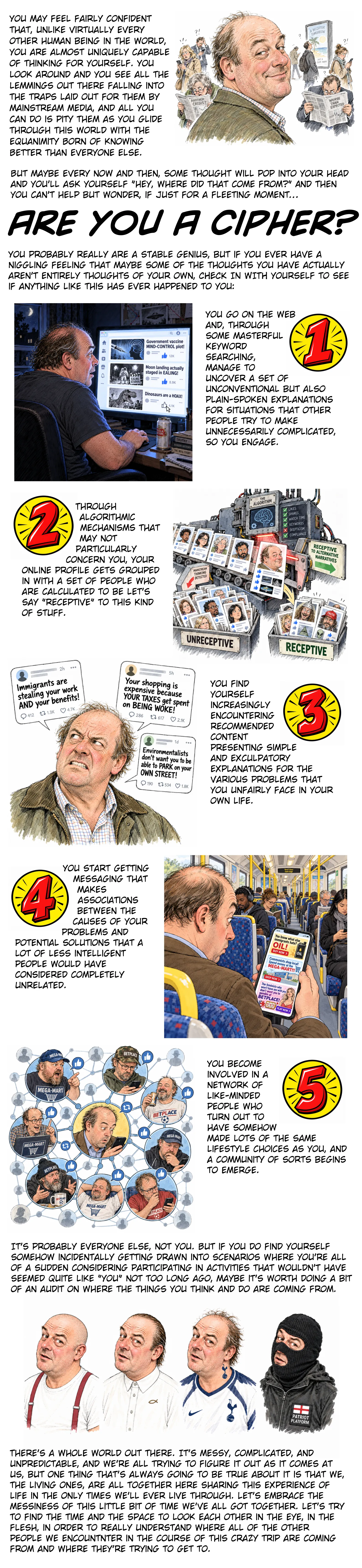
- Are You a Cipher? 27 September 2026
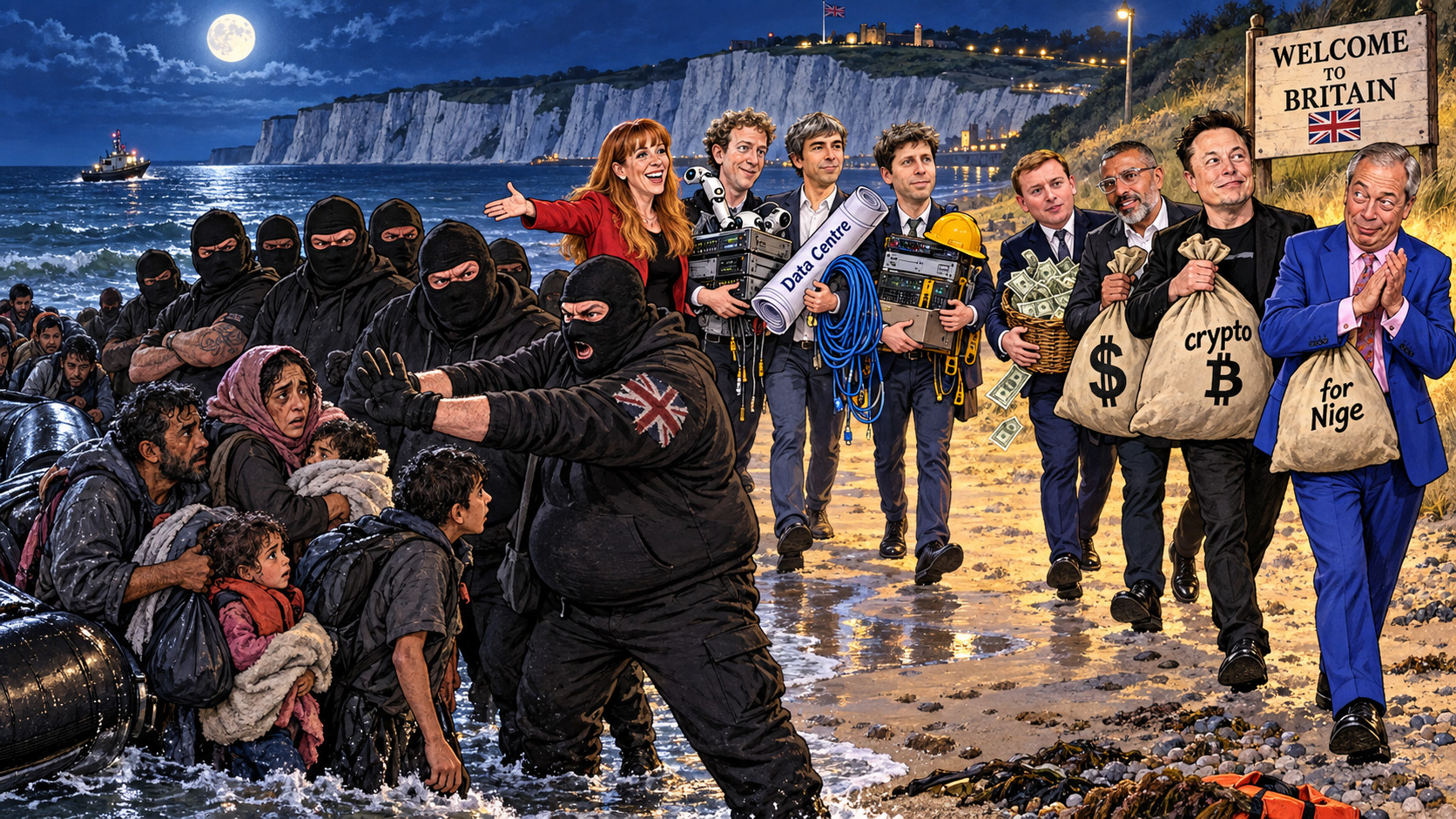
- Come On In 13 September 2026