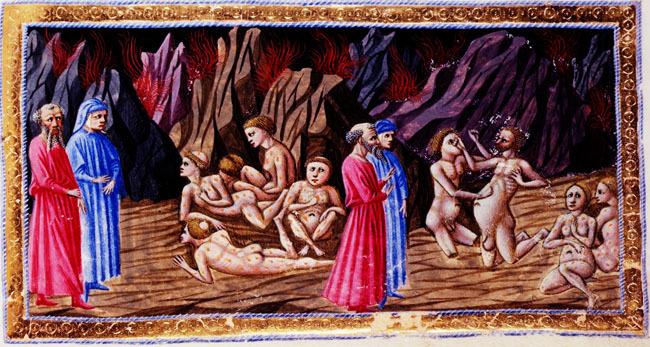
Master Adamo was a notorious counterfeiter who lived in 13th Century Tuscany, where he made convincingly realistic but fake coins for members of the Guidi courts. Adamo’s technique was to produce coins that closely resembled gold florins, but had a slightly lower ratio of gold in them than the official Florentine currency. For this he was burned at the stake, probably in 1281.
Master Adamo is remembered today almost exclusively for his appearance in Canto XXX of Dante’s Inferno, where he is placed deep in the eighth circle of hell along with a number of other characters who had committed sins involving falsification and fakery in their lives. Adamo’s contrapasso – the punishment in hell that is in some sense suited to his sin on earth – is that he lies eternally prostrate, suffering from an unquenchable thirst, his body grotesquely bloated by dropsy. The idea is that Adamo’s body, like his coins, is infused with an alien and contaminating substance; and yet, despite being full to the point of bursting with this fluid, he craves for something to drink. As Adamo was gripped by insatiable greed for wealth in life, so in death he is tormented by an unsatisfiable need for something much more basic: water.
When Dante and Virgil encounter Master Adamo in the course of their tour of hell, Adamo proceeds to engage in an argument with another one of the denizens of this corner of the Inferno, namely Sinon, the Greek warrior who was tasked with convincing the Trojans to accept the deceptive and fateful gift of a giant wooden horse. Sinon is another falsifier, specifically of words: Dante’s medieval Italian perspective, by way of the ancient Roman point of view, was that the Greeks were treacherous liars who spoke untruths in order to advance their selfish causes. (There is, incidentally, an appealing historical-literary analogy here: Sinon is a minor villain of Virgil’s Aeneid, while Master Adamo is a minor villain of Dante’s era and of his masterpiece.) Master Adamo and Sinon trade some nasty words with one another, and then things get physical, though the whole scene is pretty pathetic given that neither of the damned men can really move much. This is presumably something that happens with them all the time, forever.
So here we have Master Adamo, a medieval forger. In a way, forgery is the antithesis of another form of falsification, plagiarism: where a forger such as Master Adamo is a maker of things that are not what they claim to be, a plagiarist is someone who misdirects credit for a genuine object, forming not bad artefacts but bad associations. Plagiarists, unlike counterfeiters, impersonators, alchemists, and liars at large, do not feature as characters in the Inferno, and indeed the modern notion of plagiarism itself was not something that would have been recognised by Dante or his contemporaries. In fact Dante may have interpreted the modern preoccupation with authorship as a form of pride or vanity, sins for which he places other poets and artists in his Purgatorio. The painter Oderisi, who Dante encounters in Canto XI of the Purgatorio as he makes his way towards paradise, has this to say about fame:
Worldly renown is nothing other than
a breath of wind that blows now here, now there,
and changes name when it has changed its course.
A name on a text or a work of art, for Dante, was worth nothing more than a passing breeze.
But here we are now, getting into the thick of the 21st Century, in an era that has come be defined by these two poles of falsification: forgery and plagiarism. On the one hand, we have a culture obsessed with fakery, with fake news, fake body parts, fake millionaires, fake merchandise, fake drugs, with forged and stolen identities, where credentials are currency, where what happens to your body is a function of who you can claim you are. We commit our resources to things that are impermanent, to payment for experience, for access, to information, to a spectacle, to a space, real, virtual, maybe just to a cool room on a hot day. On the other hand, we have an economy that is increasingly tied up in the currency of information, bound more and more by notions of types of property that are immaterial. In such an economy, plagiarism is construed as not quite a capital offence, at least literally, but certainly as the theft of capital.
And emerging from all of this, to bring this all around to one of the main themes of my website, we have, either coincidentally or ineluctably, Artificial Intelligence. This is a technology that is bound up in narratives of both plagiarism and forgery. The former is the cardinal sin of the origin story of AI, a model of an informational world built on the purloined work of an entire internet’s worth of makers of sentences, sounds, and images. The latter is, it would seem, the destiny of the technology, bound as it is to produce simulacra of things that humans value, but, like counterfeited coins, always somehow a bit diminished, always returning to a slightly disappointing mean of what’s already been done.
Dante would have recognised one of these vices of AI, but probably not the other. And for what it’s worth, I have my doubts about intellectual property as a commodity, as well. In the balance between whatever value is gained by enabling people like me who write complex sentences to try to convert our efforts into profit, versus all the value that is lost by way of protectionist applications of patents along with the false economy of branding, it seems like we all inevitably come out in the red. Combine this with the way that, now, the real value of the words we say is neither the words themselves nor the corresponding meanings they make but the way that they act as simply an excipient for being heard and so exerting influence, a sparse signal to be picked up by whatever function or algorithm and then to get broadcast just for the sake of adding mass to our profiles, and I quickly lose track of what exactly it is we’re protecting with an instrument like copyright in the first place.
Then why do I choose to associate with Master Adamo, a forger? I’m not exactly sure. I think it might have something to do with the ambiguous attitude towards originality that is projected through the character Wyatt Gwyon in William Gaddis’s novel The Recognitions, who is a maker of images and other things lacking in originality and so artistic “talent”, and yet is tremendously talented at making extremely good imitations of stuff that other people had already made once. In that book, the corrupt art critic Basil Valentine famously tells Wyatt:
Originality is a device that untalented people use to impress other untalented people, and protect themselves from talented people… Most original people are forced to devote all their time to plagiarizing. Their only difficulty is that if they have a spark of wit or wisdom themselves, they’re given no credit.
When sentences are constructed first, by imperfectly encoding and decoding other sentences that have already been said, and then given meaning later, what are we dealing with, in terms of plagiarism and forgery? I think it has to be neither, or both, all the time. And, in this marketplace of stolen goods and imitations, the plagiarist is a shill, an agent on an assignment, a thrift-store buyer, just a cypher. The forger is the genuine item, smuggling something actually new past the wardens of a highly constrained organisation where everything is supposed to be familiar and plugable, where there is nothing to know and no need to communicate because everything is already known and said.
So who would Master Adamo be in our own times? A world leader, railing against the fake news that comes from anywhere other than his own department of disinformation? Or merely a state sponsored meme maker? The CEO of a tech multinational, or just another huckster trying to sell AI in wrapping paper and ribbons? An identity thief, an operator on the dark web, light-footing their way along the veins of data that we secrete, looking for a spot to plug in? A man selling rip-off designer bags from an upstairs bedsit in Stepney? A person pretending to be a machine imitating a human that occasionally does something profound, because no one is interested in human profundity anymore, because we’ve already done everything there is to do there? Or maybe he would just be a guy with a website shouting “here I am!”