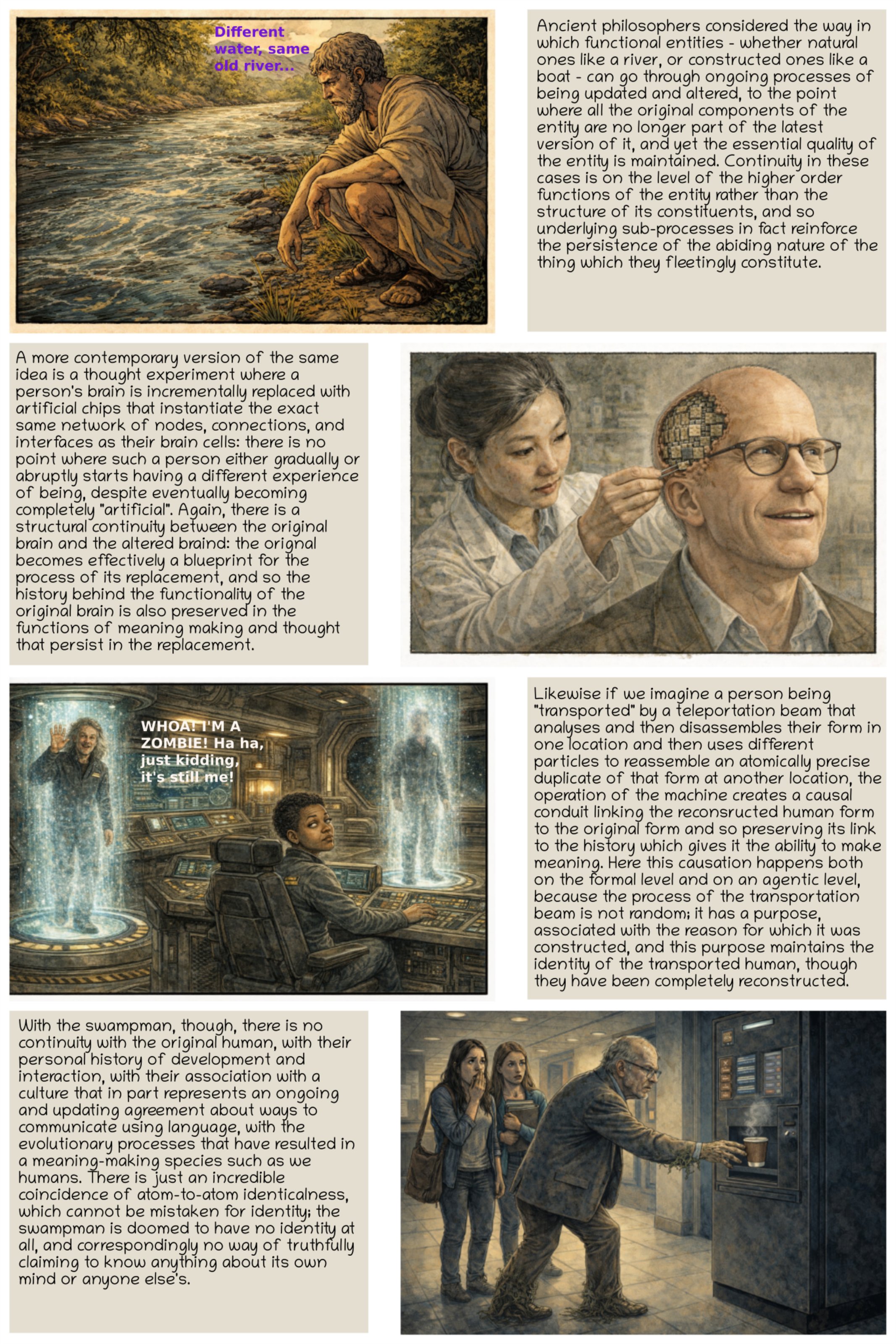
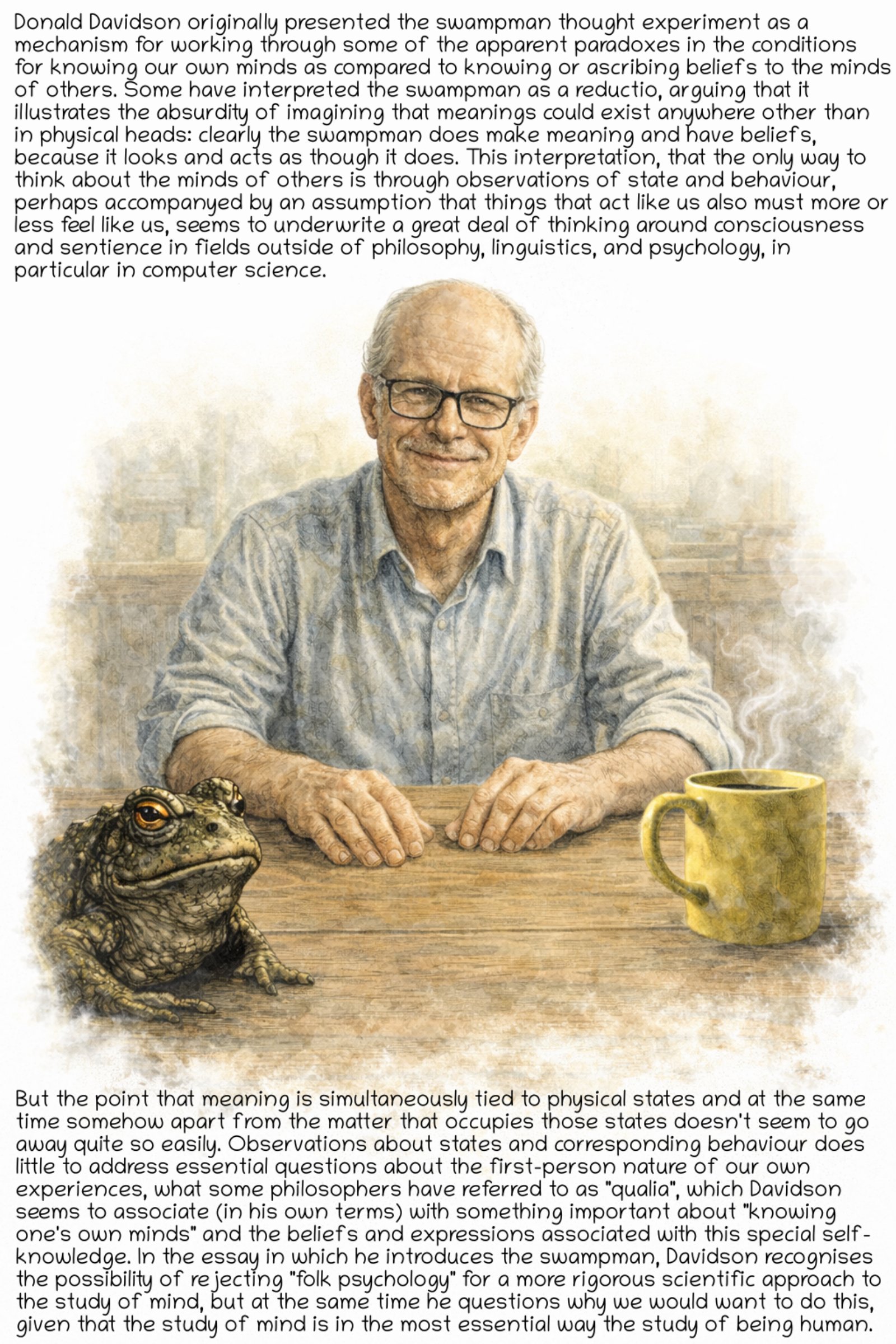
Swampman
March 2026Source material: Donald Davidson, Knowing One’s Own Mind (1987)
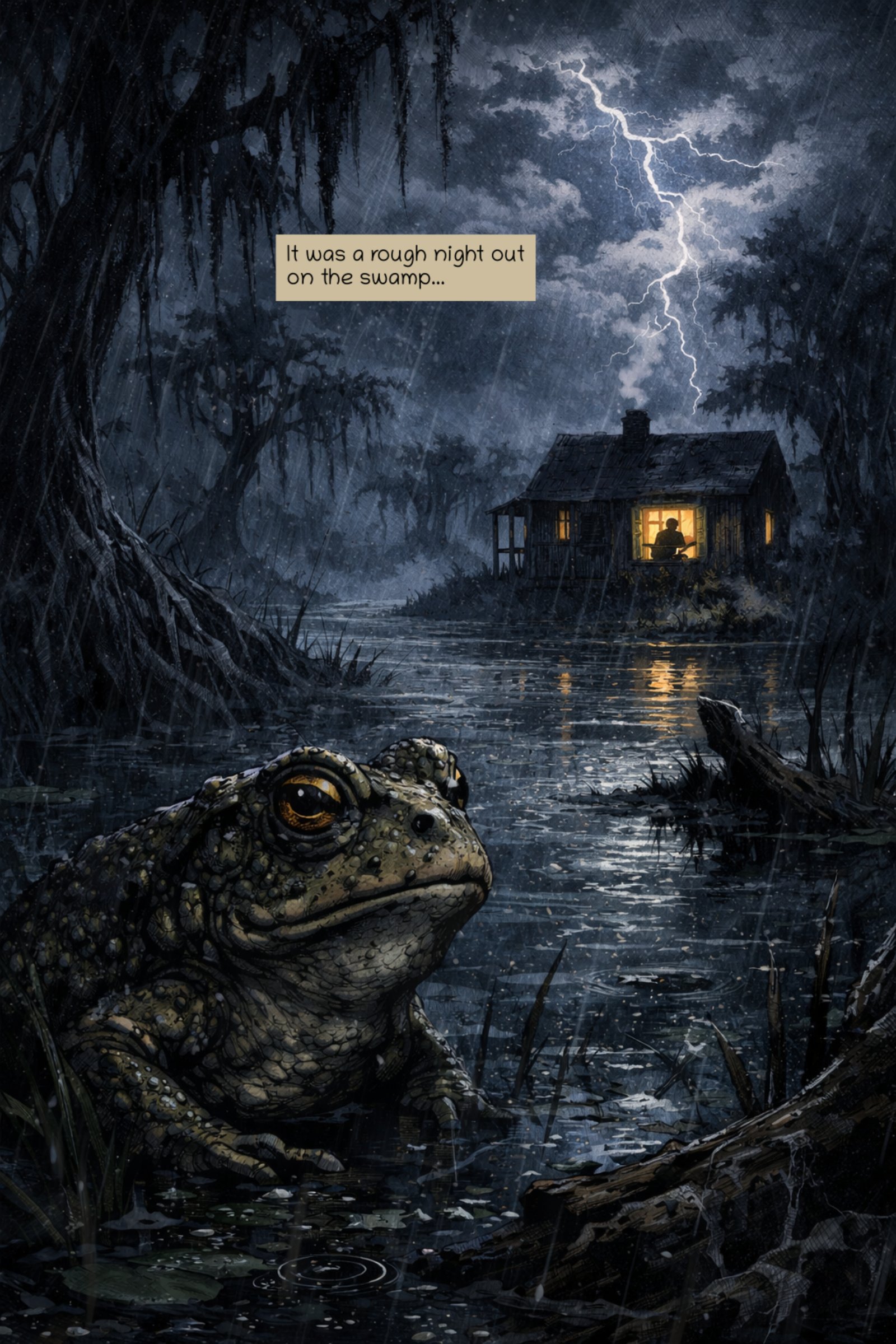
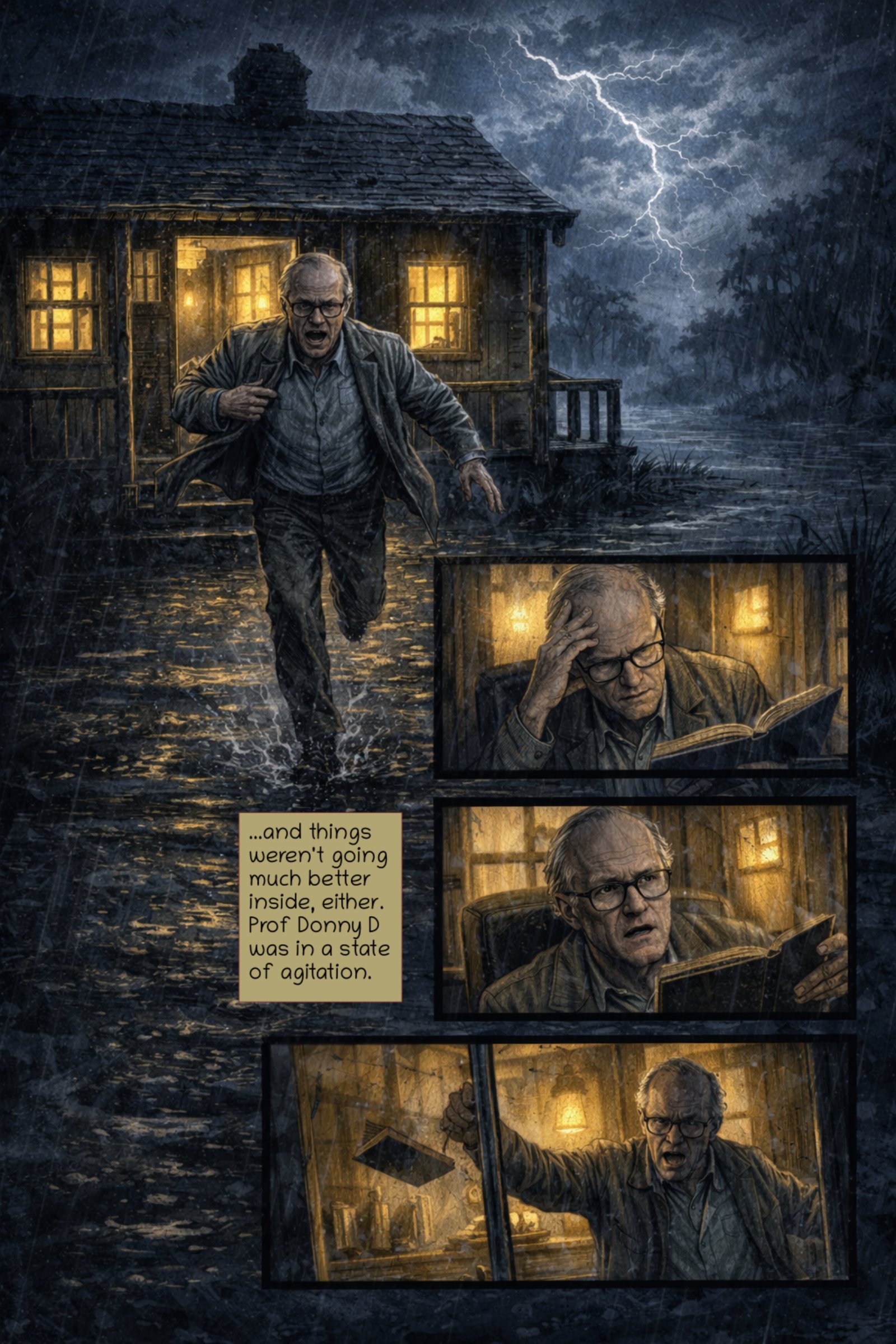
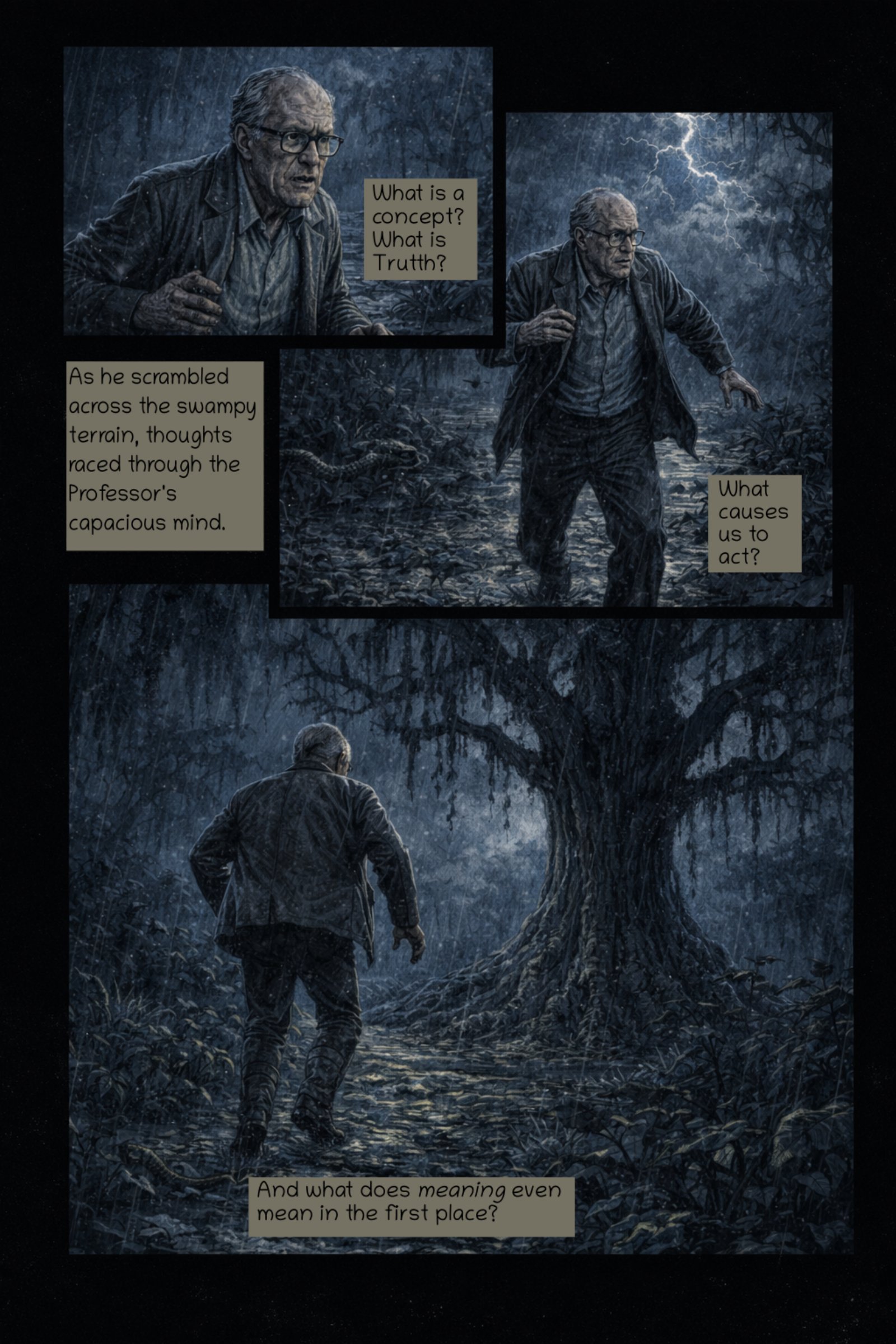
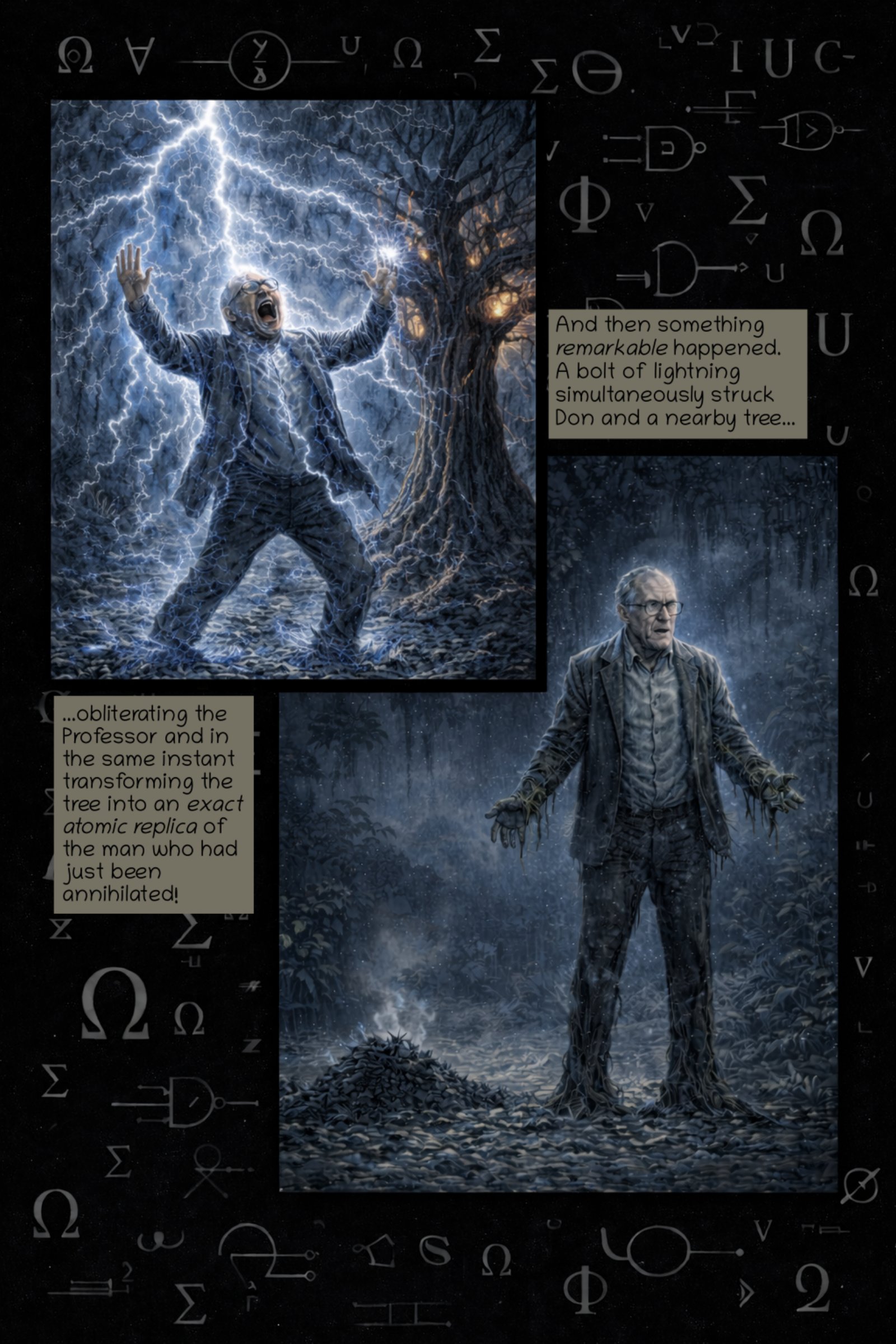
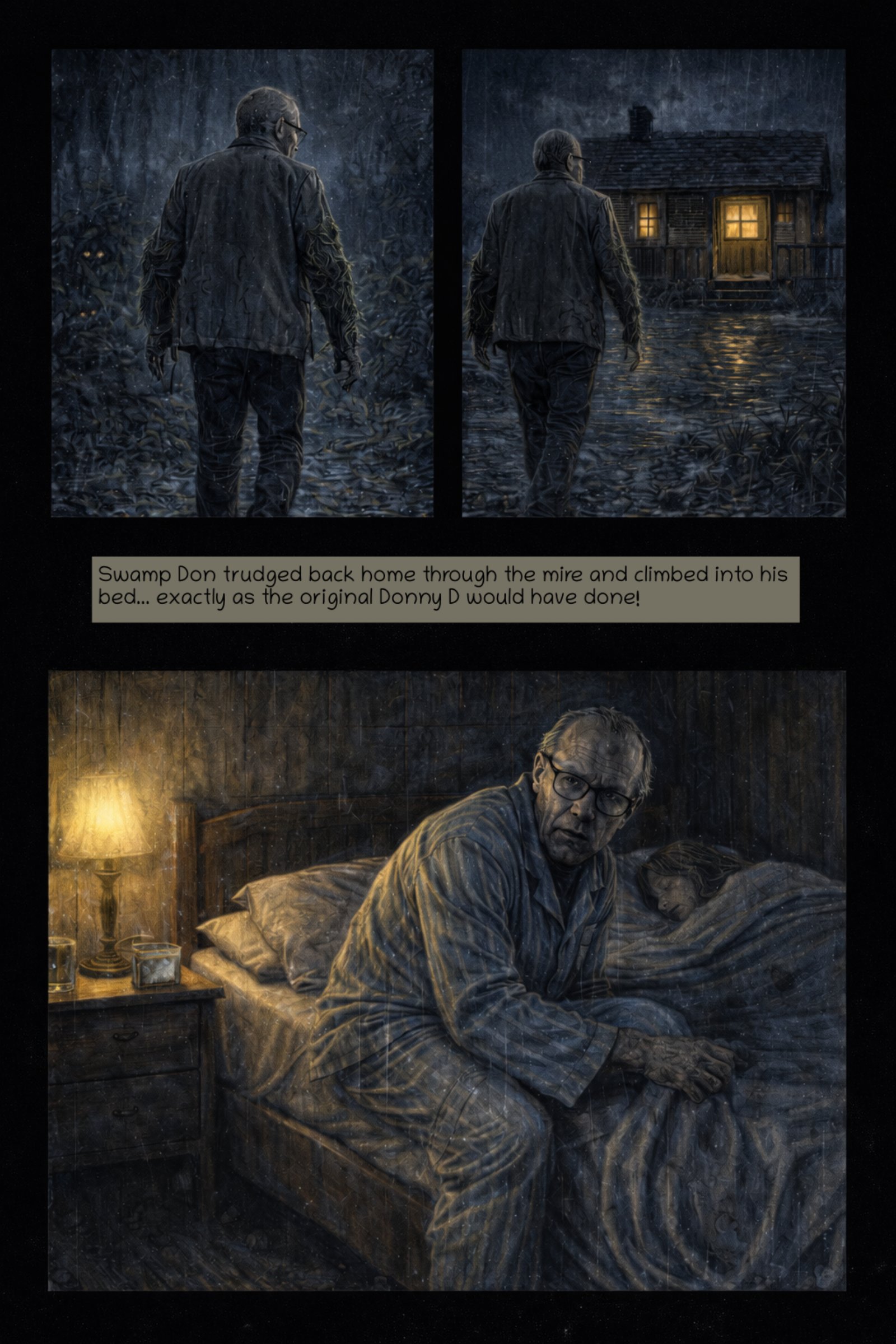
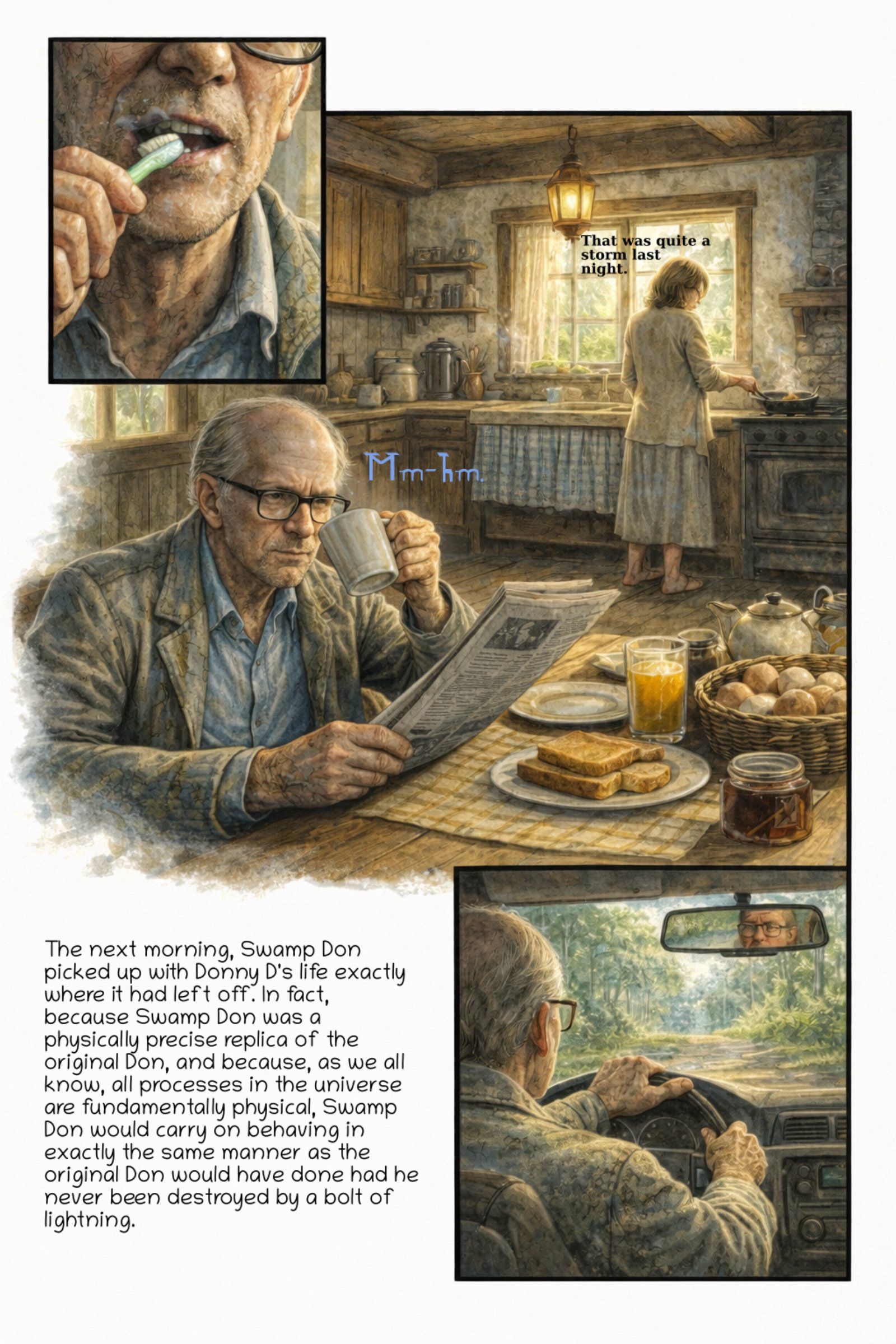
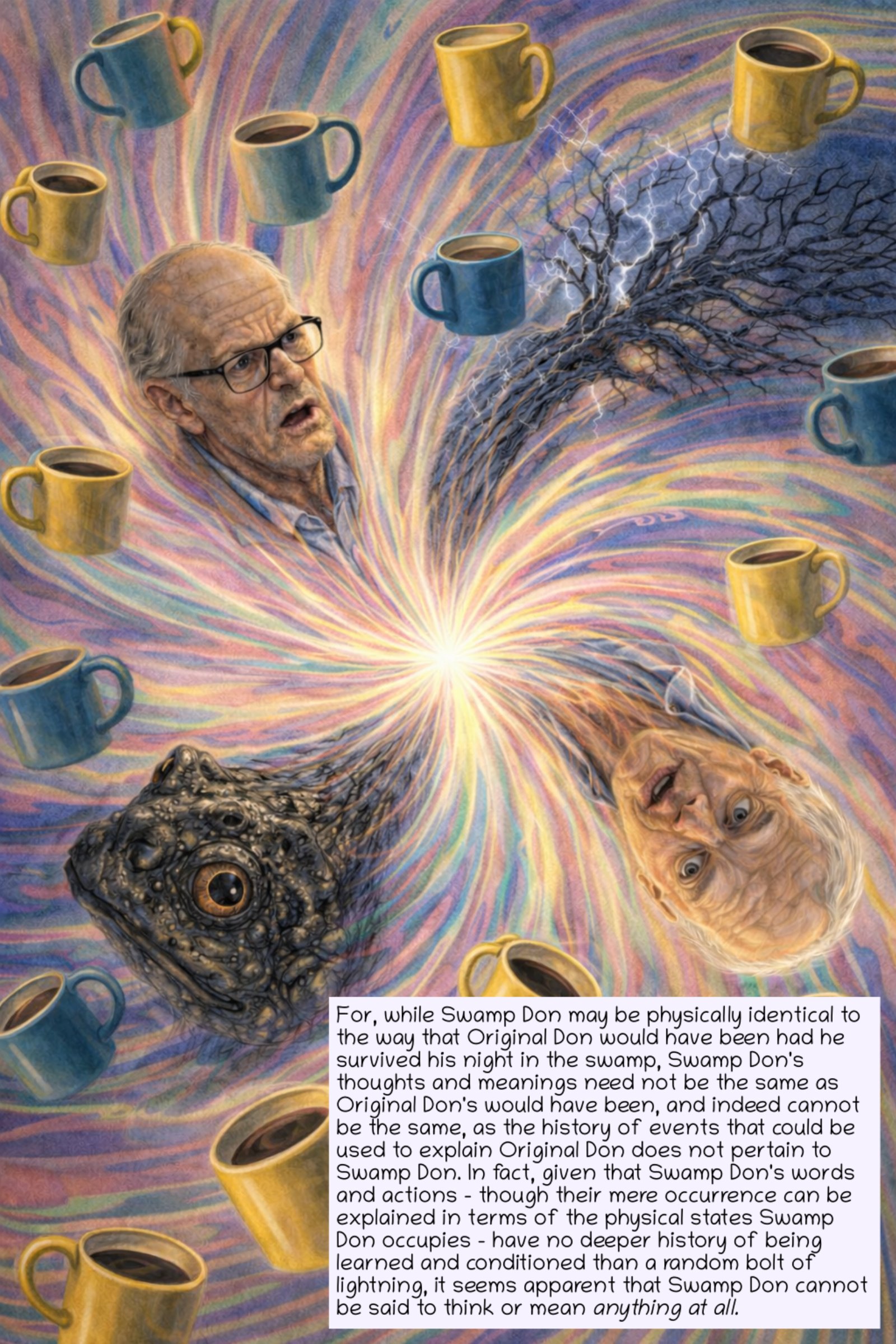
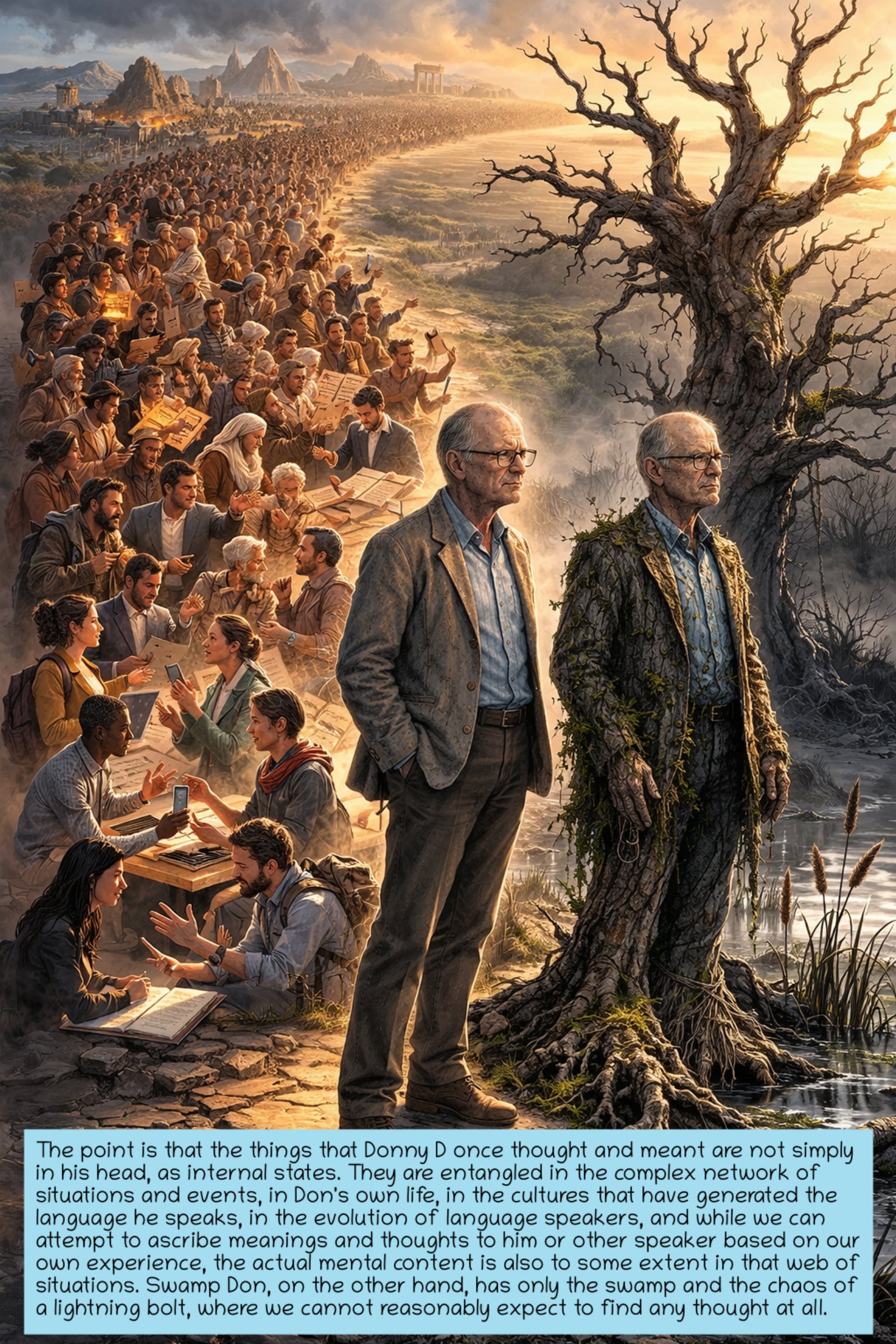
For a long time now, I’ve wanted to have a go at translating a philosophical thought experiment into a comic. There’s an obvious alignment between the objective of a thought experiment, which is to ground a complicated idea in an imagined but also visceral experience of in some sense being inside the idea that the experiment explores, and the way that the mixed media of comic books blend the visual and the textual. Both thought experiments and comics transgress the merely explanatory and didactic, mixing what is thought with what is felt. The thought experiment I’ve chosen to have a go at, Donald Davidson’s swampman, strikes me as an especially apt target, because it is a thought experiment about the personal experience of each of us having our own minds to which we each have our own privileged first person access: in other words, it is a thought experiment about having the ability to do thought experiments, and what conditions must exist to make that possible.
I’m hardly the first person to take a crack at exploring this particular thought experiment through the multi-media of comics, in one way or another. My own introduction to Davidson’s argument against either a completely reductionist or an entirely internalist theory of mind happened in the offices of Prof Mark Bishop at Goldsmiths College when I had the great privilege of being one of the students on his fantastic MSc programme in Cognitive Computing. A computer science course might seem like an unusual place to encounter Davidson’s work, which has been noted for the density of both its presentation and substance. The swampman stands in contrast to for instance Alan Turing’s imitation game, or John Searle’s Chinese room, both of which have become part of the computer scientific canon and broader tech culture, but then Prof Bishop’s course was itself exceptional, and Davidson’s ideas fit in well with an academic programme which, while presented in the context of computer science, was principally concerned with rejecting the notion that minds could be anything like computers.
With this in mind, I think what Davidson had to say in 1987, when the swampman first made his appearance in print in the essay Knowing One’s Own Mind (based on a lecture Davidson had delivered the year before), is of the utmost relevance to people concerned with technology that seeks to simulate intelligence in 2026. It is interesting that Davidson’s thought experiment has gained less traction with people who work with computers than some other thought experiments, and I wonder if one reason for this is that the outcome of the experiment appears to be negative from the perspective of anyone who would like to argue that a machine can be said to think for itself, more absolutely than Searle’s Chinese room and in direct contrast to Turing’s imitation game. I will try to get to this by the end of the comic itself. But by way of an introduction to the comic, I would like to offer two disclaimers.
The first disclaimer is that I am not a professional philosopher. I have a lot of respect for people who do make their livings working with ideas about what our lives mean and how we can do a good job of living them, which I’ll offer as one of many possible glosses for “what philosophers do”. Philosophy is a rough game to play: funding is hard to come by, so there is a lot of sometimes fairly intense competition between philosophers, on top of which the field has become, absurdly, a target for tropes about pointless intellectual pursuits. When it becomes fashionable for entire sectors to attack philosophy degrees as an example of an impractical use of education, we need to suspect that there is a movement afoot to prevent the public from thinking too hard about the times in which we live.
I do work in the tech space, specifically on artificial intelligence, and I am increasingly agitated to be involved in a field where many of my colleagues, sometimes with good intentions, think they can do without the critical perspectives of philosophers (along with often rejecting other relevant disciplines such as linguistics, sociology, psychology, and the humanities at large). I’ll note in particular that the aforementioned imitation game thought experiment and the corresponding “Turing Test”, a favourite of computer scientists and AI enthusiasts, was conceived in the 1950s in an era in which psychology was in thrall to behaviourism, an approach to mind which essentially rejects any recourse to mental content. One of the tragedies of Turing’s untimely death was that he would not live to see the behaviourist approach dismantled, beginning with the linguistic front of what became known as the cognitive revolution.
We will never know what meaningful contributions Turing, who was exceptional in his ability not only to think about complex systems but also to communicate about them, could have made to the way we understand ourselves in a world of information processing machines in light of the rapid changes that happened in his and other related fields shortly after his death. But many people who work with computers and computational models in the 2020s seem to be stuck in the mid-20th Century with Turing, either unaware of or uninterested in the great deal of thinking-about-thinking that has taken place since then, thinking that has often taken into account among many other things advances in fields like neuroscience and information technology. The consequences of this disconnect spill into industry and indeed politics, with for instance hysteria around sentient and antagonistic machines serving as a kind of straw man that enables a techno-military-industrial complex and a corresponding concentration of resources and authority that threatens to disrupt the foundational principles of a society where diversity of thought is cherished. Wittgenstein has a famous quip which goes “philosophical problems arise when language goes on holiday” - to this we might consider adding “and technological problems arise when philosophy gets kicked out of the room”.
And so I have injected a good deal of my own non-expert, language-tech-oriented interpretation of Davidson’s thought experiment here, informed by my own understanding of how the experiment (which is really only a minor part of one fairly short paper) fits into the broader work of Davidson and some other thinkers. I say this partly to preempt any no doubt justified objections to the interpretive liberties I’ve taken: in my defence, surely part of the purpose of a thought experiment is as a basis for thinking things through. But I have also chosen this particular thought experiment in part because of what I see as its inherent relevance to people who think about and develop technology heading into the second quarter of the 21st Century, and I do have an agenda here.
The second disclaimer is that I am not a visual artist, at all. I would consider myself to be very close to the low end of the spectrum of graphic talent, and a substantial obstacle to my attempting this little experiment-with-an-experiment until now has been my own inability to even begin to conceive of the crucial visual element of the work combined with the completely reasonable disinterest in committing time and energy to what amounts to a thing I’d like to try on the part of anyone who does have an idea of how to draw, combine text with images in a coherent way, compose panels of text-and-image into fluid and aesthetically palatable page layouts, or string these pages together in a way that tells a story that people are interested in seeing and reading. Given that my own contribution to the comic amounts to an amateur interpretation of an inherently contentious and already much debated passage of philosophy, the incentive for a real artist to get involved is understandably minimal.
This impediment has in the present instance been overcome with, either ironically or suitably enough, the assistance of artificial intelligence. I have used ChatGPT 5.2 to turn my rough ideas for a visual and somewhat embellished recreation of Davidson’s thought experiment into a concrete artefact. To be clear, I have not used any work from other artists directly as templates or guidelines or as any other sort of input to generative AI, nor have I used any kind of instructions like “you should draw something in the style of so-and-so”. I found that the most effective way to work was to go through my rough idea for a way of telling the story of the swampman page by page, allowing a style to emerge and then feeding elements that worked back into the model to maintain some kind of aesthetic consistency. Things worked best for me when I asked for output on the level of a page and refrained from overconstraining the model, and things didn’t go as well when I tried to be too specific about some detail or when I involved myself too much in the precise layout of a page. Strange things can also happen when working iteratively with an image involving more than one human figure. There is really only one persistent character in the story that’s told here, and the model did a good enough job of reproducing different views of that character from scene to scene when I presented it with its own prior output as subsequent input. I can see how things might have gotten quickly off track if I had tried to tell a more complex story with different combinations of people interacting in different ways, though. (And I did use some public domain photographs of a few notable figures from philosophy as the basis for some of the characters who make appearances in the comic, an application that I’m confident falls under fair use - hopefully this will be mildly amusing for any readers who recognise the real life people I’ve worked into the comic.)
Now, I am aware that just because I refrained from directly misappropriating anyone else’s work in the prompts I used to make my own comic book version of the swampman, none of the entities involved in the creative work - the model, its developers, or indeed me as the downstream user - are necessarily off the hook in terms of obligations to intellectual property right holders who might identify traces of their own work in the output I’ve gotten from a model. I think this is an important issue, and I don’t want to avoid it. There is one way of thinking about data-driven generative models, like LLMs, as “learners” that study the work of creative humans and incorporate various elements of style into their own “thinking”. I find this description some combination of misinformed and wilfully incorrect, though; I think it is accurate to conceive of these models as lossy compressors that output skewed versions of their own training data. By this interpretation, it is difficult to see how at least certain specific instances of the output of an LLM does not qualify as theft of intellectual property. Surely if I pirate copyright protected material and distribute it as a compressed file, I am violating the IP rights of the creators of the material; that the decompression of the data I’ve pilfered is imperfect does not change the basic nature and intent of my action.
And yet… the history of art is full of instances of imitation, many of which seem to very clearly transgress the boundaries of mere flattery and present themselves as outright plagiarism. But in another era, the adjacency of for instance Giogione’s Sleeping Venus and Titian’s Venus of Urbino was understood as an indication of a conversation between creators and creations alike (to the extent that it is now widely believed that Titian worked on both pieces), not as the theft of an image or an idea (something similar could be said for the fluidity of various details of plot, character, and sometimes precise sequences of words that run through a great deal of for example Elizabethan literature).
Does this mean that a non-artist like me can rationalise the application of generative AI to tell a textual-visual story I couldn’t otherwise have told, about an idea I got from someone else, as a sort of detournement, reappropriating the traces of the forms created by other more talented people to patch together something that isn’t quite new but is more found than stolen? I’m not sure if I can go that far. I think there is still a reckoning that needs to be had in terms of the debt that models and their outputs owe to the people whose work has made this modelling possible, and a reconsideration of the paradoxical rules that tech companies seem to simply invent for themselves and for others about what counts as legitimate applications of data. But I also think we may be due for a reconsideration of how, in general, we think about creativity and the ways that we have ideas in our heads, find signals in the world around us, and use these things to make meaning. This question of what it means to be a meaning-maker is the object of Davidson’s thought experiment, and so I’ll leave it here.